
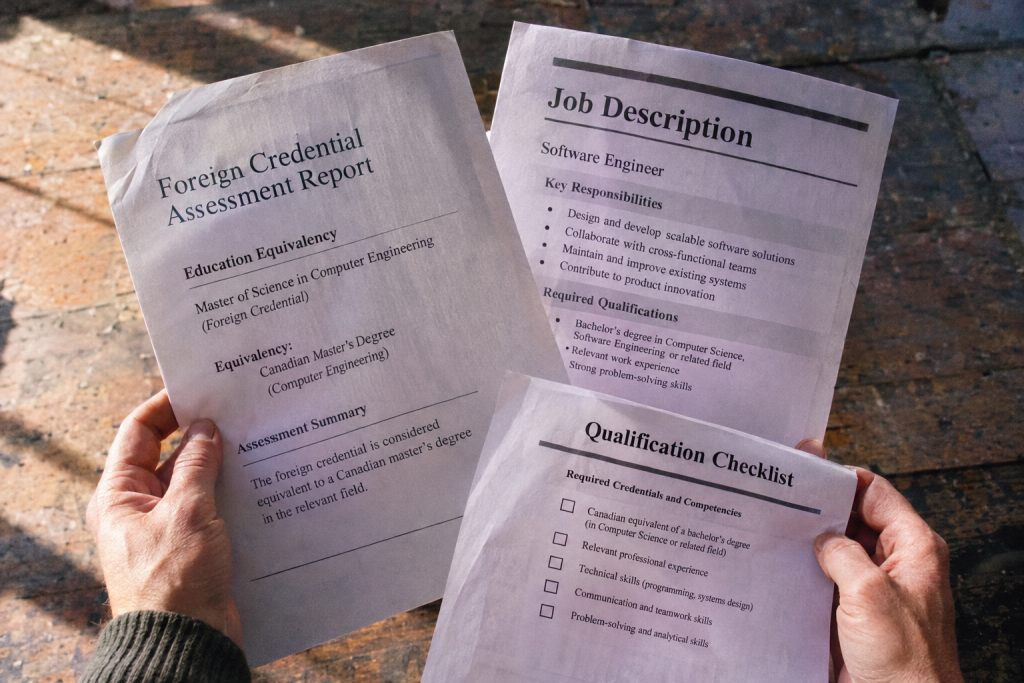
Foreign credential recognition matters when an employer is assessing a candidate whose economic immigration application is moving through the permanent residence system. Processing-time changes can affect a candidate’s planning, but they do not establish whether that person’s education meets your role requirements or whether they are authorized to work.
Use the processing update as context, not a hiring decision
Immigration, Refugees and Citizenship Canada (IRCC) has published updated processing-time information, with the reported direction differing between several economic pathways and spousal sponsorship. The CIC News report on the latest processing-time update is a useful reminder that timelines are not uniform across application types.
For an employer, the practical point is limited: a published processing estimate is not a hiring date, a promise that an application will be approved, or evidence of professional competence. Do not make a start date or staffing commitment depend on an assumed permanent residence decision. Confirm the candidate’s qualifications and right to work through separate, appropriate checks.
Processing times can change, and an individual file may not follow a published estimate. If immigration timing is relevant to a workforce plan, check current information directly with the responsible government department and discuss the candidate’s own circumstances with them. Do not try to interpret or manage the person’s immigration application on their behalf.
Build a foreign credential recognition process around the job
Start by separating essential requirements from preferences. Identify the education, licence, experience and job tasks that are genuinely necessary for the position before reviewing a candidate’s documents. That makes it easier to compare applicants consistently and reduces the risk of treating an unfamiliar institution or document format as a sign of lower ability.
Foreign credential recognition is not a single test that answers every hiring question. A credential assessment may help explain how education compares, but it does not by itself establish that a person can perform a particular job, hold a regulated licence or meet every requirement your organization has set.
Write down what evidence you will consider for each requirement. Depending on the role, that could include academic records, a credential assessment supplied by the candidate, work samples, structured interview questions, references or a practical assessment. Use only checks that relate to the job and apply the same standards to candidates competing for the same position.
Set a repeatable review sequence
- Define the role. List required knowledge, tasks, education and any licence or registration that must be in place to perform the work.
- Identify evidence. Decide which documents or assessment methods can demonstrate each requirement, and what you will do if a document is unavailable or difficult to interpret.
- Apply consistent criteria. Use the same scoring approach for comparable applicants and record job-related reasons for your assessment.
- Check gaps directly. Ask focused questions about the candidate’s education or experience rather than making assumptions based on country of study, accent or unfamiliar terminology.
- Confirm role conditions. Before making an offer, confirm any licence, registration, work authorization or other condition that is essential for the proposed duties and start date.
Separate academic equivalency from permission to practise
Some occupations have licensing or registration requirements that are set by the relevant authority for the occupation and jurisdiction. An employer should identify the actual requirement for the position and verify it through the appropriate regulator or other responsible authority. A general credential assessment should not be treated as a substitute for a required licence.
For roles that are not regulated, your organization still needs a defensible way to determine whether education and experience match the work. Consider whether the candidate can demonstrate the required knowledge through relevant work history, a skills assessment or another job-related method. Avoid requiring a particular Canadian credential where an equivalent qualification or demonstrated skill would meet the actual need.
Be clear about which requirements are mandatory before employment and which can be developed after hiring. If a licence is essential on the first day, state that early in the recruitment process. If a skill can be learned through training, make that distinction in the job criteria rather than screening out candidates for lacking a qualification the job does not require.
Make the assessment fair, explainable and proportionate
A structured process helps hiring managers focus on evidence instead of assumptions. Use consistent questions about the candidate’s work, training and responsibilities, and assess answers against the same criteria. If you use a test, make sure it measures a task or capability needed in the role and explain the format in advance.
Ask for only the information needed to evaluate the application. Treat educational and identity documents as sensitive personnel information, limit access to people involved in the hiring decision, and follow your organization’s practices for secure storage and disposal. If a document is unclear, ask the candidate to clarify it rather than deciding that it is unreliable without checking.
Record the decision in concise, job-related terms. Note which requirement was assessed, what evidence was considered and whether the requirement was met or needs follow-up. This gives your team a consistent basis for decisions and helps identify whether your criteria are excluding candidates for reasons unrelated to the work.
Plan hiring steps without relying on an immigration estimate
Discuss recruitment milestones with the candidate, including document review, any required professional authorization, references and the proposed start date. Treat the start date as conditional on the requirements that apply to the position being satisfied. If the timing changes, update the candidate and the hiring team rather than assuming that a permanent residence application will resolve the issue by a particular date.
Confirm authorization to work in Canada separately from education and professional qualifications. Newcomers do not all have the same right to work, and a permanent residence application alone should not be treated as confirmation. Ask only what is needed to confirm the candidate’s right to work, not for immigration information beyond that purpose.
For a practical checklist on checking work authorization before finalizing an offer, see this guide to verifying work rights as part of the job-offer process. If the person needs immigration advice about their own application, they should consult a licensed representative; an employer or recruiter should not act as the candidate’s representative.
Prepare managers to use the person’s skills well
Once a candidate is hired, connect the qualifications you assessed to the work the person will actually do. Agree on responsibilities, performance measures, training and who will answer questions during the first weeks. This creates a fair way to identify whether a gap is about job-specific procedures, unfamiliar terminology or a genuine skills need.
Do not assume that a credential tells you everything about a person’s strengths, or that an overseas qualification automatically maps to a Canadian job title. Ask the new employee what parts of their experience are most relevant to the role, then compare that discussion with observed work and established performance standards.
For additional planning on the first stage after a hire, use this resource on structuring newcomer onboarding. Keep the focus on clear duties, access to training and regular feedback, not on the employee’s immigration pathway.
Keep immigration and employment compliance distinct
A permanent residence pathway and permission to work are separate considerations for an employer. If the candidate will work under a temporary authorization, confirm the terms that apply before the person starts and do not assume that a pending permanent residence application changes those terms. The correct hiring route depends on the worker’s circumstances and the requirements in force at the time.
If you are hiring a temporary foreign worker, review the applicable conditions and keep the offer and actual working arrangements aligned. Employers hiring temporary foreign workers must meet the relevant obligations; consult the government’s employer compliance information and check current programme requirements before proceeding. Do not treat a credential review as a substitute for immigration or employment compliance.
Keep the decision-making tasks with the right people: hiring managers assess job-related qualifications, the appropriate authority determines any licence or registration requirements, and the candidate or their licensed representative handles personal immigration advice. Clear boundaries reduce delays and help prevent an employer from promising an outcome it cannot control.
Turn the assessment into a better hiring decision
Review your process before the next recruitment begins. Check whether each education requirement is necessary, whether your team knows how to interpret evidence from different systems, and whether you have a consistent way to assess equivalent experience. Where managers are uncertain, give them an escalation route rather than leaving each person to create their own standard.
Then make the hiring decision on the full set of job-related evidence: qualifications, relevant experience, demonstrated ability, any required professional authorization and confirmed right to work. Immigration processing information can inform workforce planning, but it cannot replace those checks or determine an applicant’s suitability.
Looking for candidates who bring international education and experience? Register with Newcomers Jobs and post a job to connect with newcomers to Canada.